This article describes the API endpoints used to view and manage the access that Users and Groups are granted to Datasets, including whether they can edit the Dataset, granted directly to a User or indirectly via Group membership:
/api/dataset/access: Returns the Groups and Users that have access to a Dataset, identifying which have edit access: directly or via Group membership./api/group_dataset: View, grant, and revoke a Group's access to Datasets (with optional edit access)./api/user_dataset: View, grant, and revoke a User's access to Datasets (with optional edit access).
Prerequisites:
- Set up API access, verify that you have API access, and obtain a token via the get_token call OR
- Generate Personal API Token.
NOTES:
- Only Admin Users and Power Users with edit access to the Dataset can execute these API calls.
- See the Dataset API article for API calls on all Dataset-related objects.
Table of Contents
1. Access Admin > System > API Toolkit
2. Retrieve Users and Groups with Access to Dataset
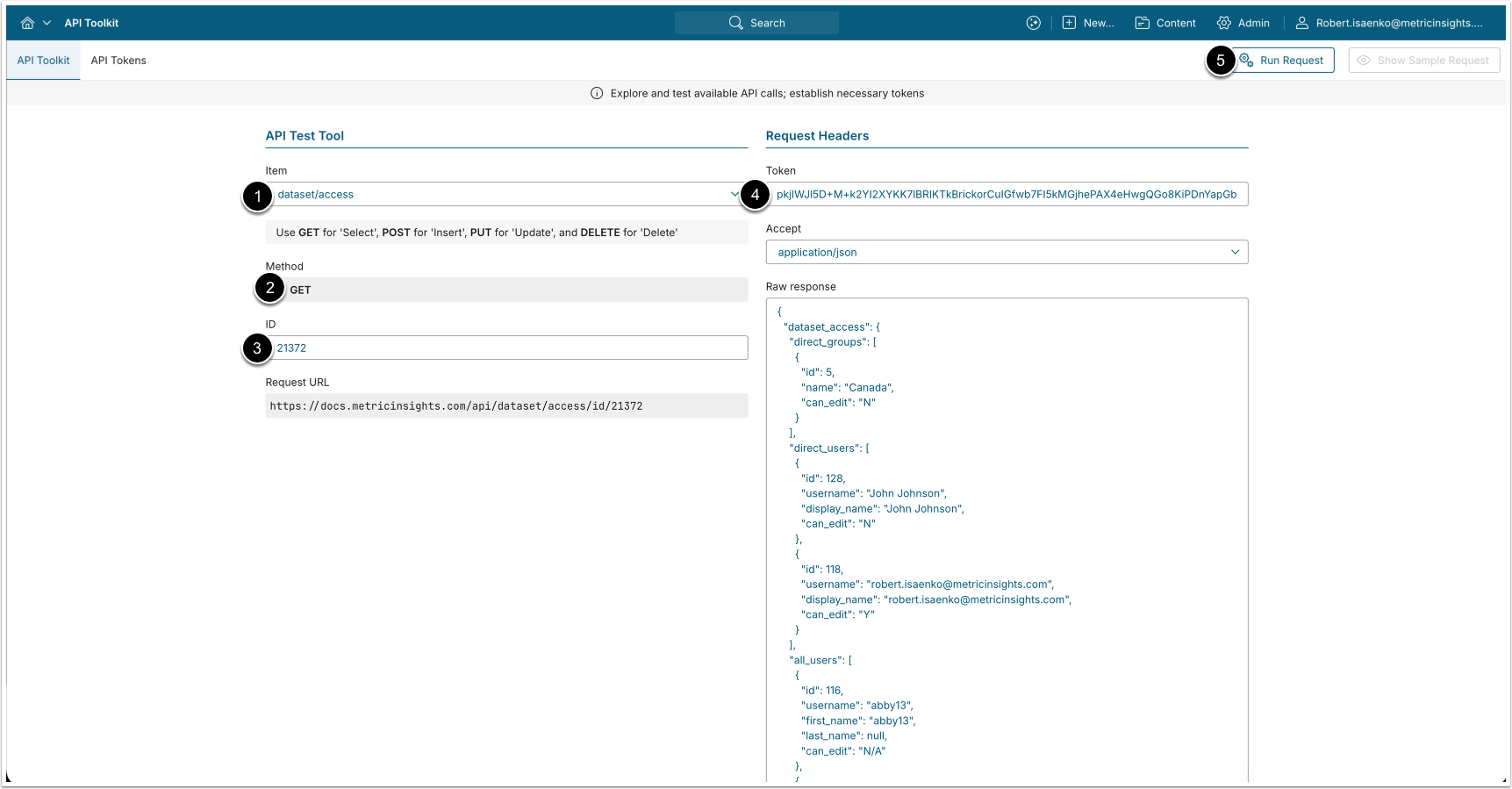
A GET request to /api/dataset/access/id/<id> returns the Groups and Users that have access to the specified Dataset. The response shows which Groups have access (and whether their members can edit), the Users with direct access, and all Users with access (directly or via Group), excluding Admins.
- Item: dataset/access
- Method: GET
- ID: Enter the ID of the Dataset.
- Enter an API Token.
- [Run request]
Example Response
{
  "dataset_access": {
    "direct_groups": [
      {
        "id": 53,
        "name": "Documentation Group",
        "can_edit": "Y"
      }
    ],
    "direct_users": [
      {
        "id": 168,
        "username": "testuser@metricinsightstest.onmicrosoft.com",
        "display_name": "Test User",
        "can_edit": "N"
      }
    ],
    "all_users": [
      {
        "id": 193,
        "username": "johnpowers.writer@metricinsights.com",
        "first_name": "John",
        "last_name": "Powers",
        "can_edit": "Y"
      }
    ]
  }
}Fields Description
| Parameter Name | Value Type | Description |
|---|---|---|
dataset_access | object | Contains the Groups and Users with access to the Dataset. |
direct_groups | array | Groups with access to the Dataset. |
Below are the Group object parameters from the direct_groups array: | ||
id | integer | The ID of the Group. |
name | string | The name of the Group. |
can_edit | string | Whether the Group's members can edit the Dataset.
("Y"/"N") |
direct_users | array | Users with direct access to the Dataset. |
all_users | array | All Users with access to the Dataset (directly or via Group), excluding Admins. |
Below are the User object parameters from the direct_users and all_users arrays: | ||
id | integer | User ID. |
username | string | Username. |
display_name | string | User's first and last name. (Returned in direct_users.) |
first_name | string | User's first name. (Returned in all_users.) |
last_name | string | User's last name. (Returned in all_users.) |
can_edit | string | Whether the User can edit the Dataset. ("Y", "N", or
"N/A") |
3. Configure Group_Dataset Associations
The /api/group_dataset endpoint retrieves which Groups have access to which Datasets, and allows granting and removing that access. Each data entry has a unique ID and represents a single Group-to-Dataset mapping.
3.1. Retrieve Groups With Access to Dataset
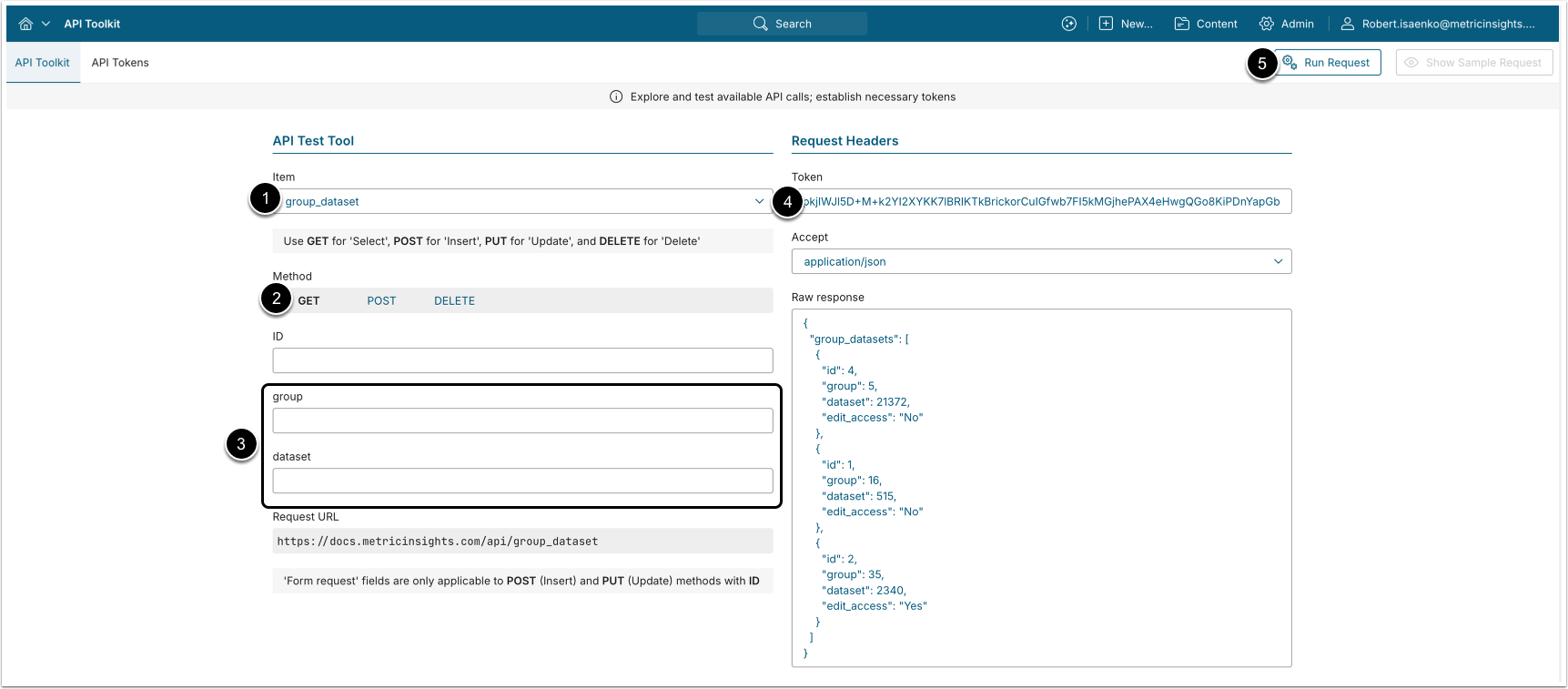
NOTE: The ID of each group_dataset data entry is unique and can be used to delete existing entries.
- A GET request to
/api/group_datasetreturns all Group-to-Dataset access mappings. - A GET request to
/api/group_dataset/id/<id>returns a single Group-to-Dataset mapping by ID.
- Item: group_dataset
- Method: GET
- Filter the results with the following parameters:
- group: The ID of the Group.
- dataset: The ID of the Dataset.
- Enter an API Token.
- [Run request].
Example Response
{
  "group_datasets": [
    {
      "id": 1,
      "group": 2,
      "dataset": 53,
      "edit_access": "Yes"
    },
    {
      "id": 12,
      "group": 4,
      "dataset": 204,
      "edit_access": "No"
    },
    {
      "id": 8,
      "group": 14,
      "dataset": 78,
      "edit_access": "No"
    }
  ]
}Fields Description
| Field Name | Value Type | Description |
|---|---|---|
id | integer | The ID of the group_dataset data entry. |
group | integer | The ID of the Group. |
dataset | integer | The ID of the Dataset. |
edit_access | string | Whether the Group's members can edit the Dataset.
("Yes"/"No") |
3.2. Grant Group Access to Dataset
NOTE: A Group cannot be granted access to a Dataset it already has access to. To change a Group's edit access, remove the existing mapping first, then create a new one.
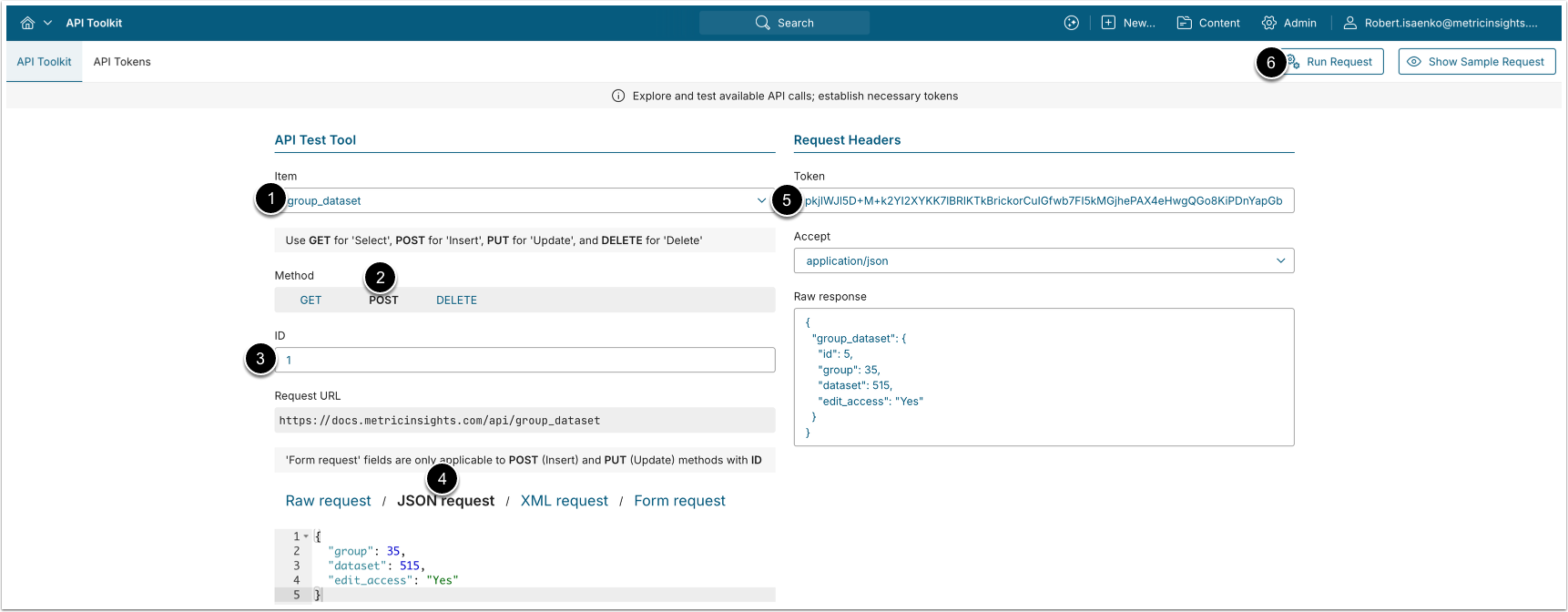
A POST request to /api/group_dataset grants a Group access to the Dataset.
- Item: group_dataset
- Method: POST
- Enter the ID of an already existing
group_datasetdata entry.- See the Retrieve Groups With Access to Dataset section for details.
- Choose JSON request and provide the following values:
- group: The ID of the Group to grant access to.
- dataset: The ID of the Dataset.
- edit_access: Whether the Group's members can edit the Dataset. ("
Yes"/"No", optional, default "No".)
- Enter an API Token.
- [Run request]
3.3. Remove Group Access from Dataset
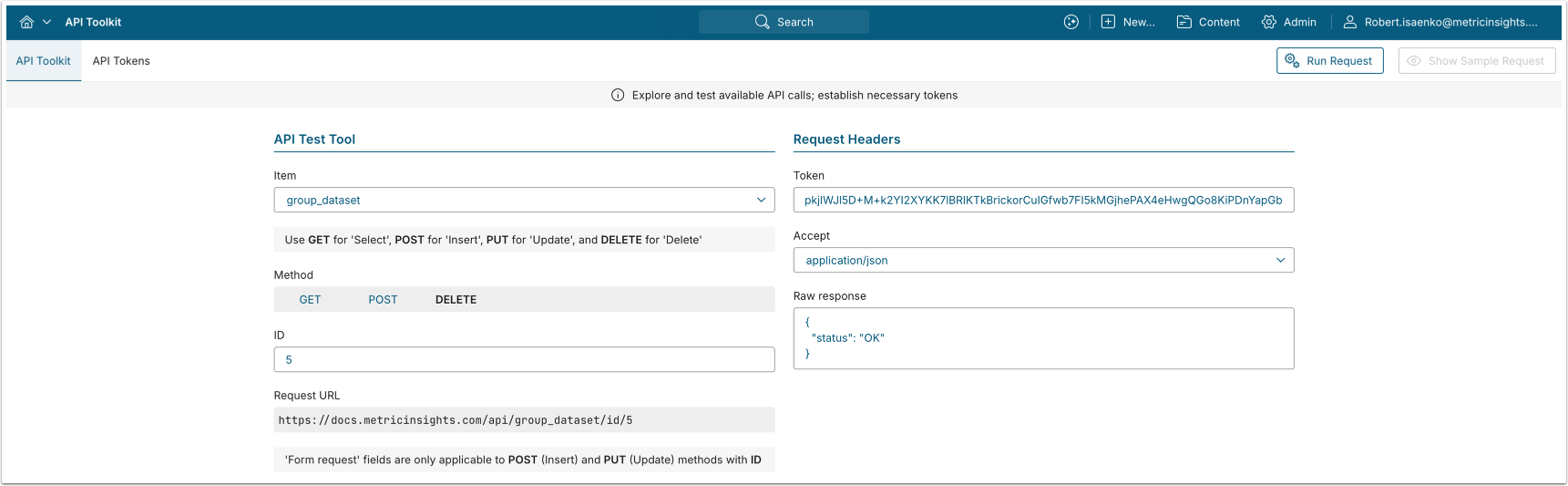
A DELETE request to /api/group_dataset/id/<id> removes a Group's access to the Dataset.
- Item: group_dataset
- Method: DELETE
- Enter the ID of the
group_datasetdata entry to be deleted.- See the Retrieve Groups With Access to Dataset section for details.
- Enter an API Token.
- [Run request]
4. Configure User_Dataset Associations
The /api/user_dataset endpoint retrieves which Users have access to which Datasets, and allows granting and removing that access. Each data entry has a unique ID and represents a single User-to-Dataset mapping.
4.1. Retrieve Users With Access to Dataset
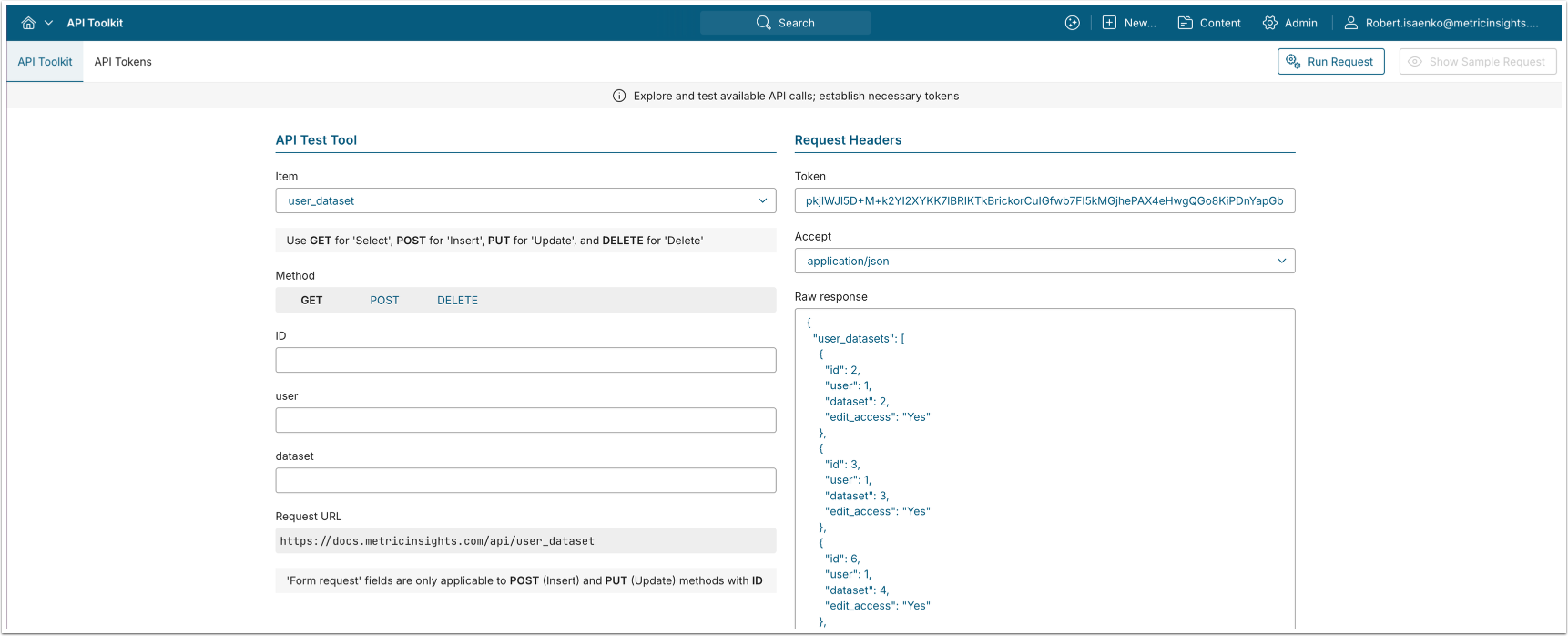
NOTE: The ID of each user_dataset data entry is unique and can be used to delete existing entries.
- A GET request to
/api/user_datasetreturns all User-to-Dataset access mappings. - A GET request to
/api/user_dataset/id/<id>returns a single User-to-Dataset mapping by ID.
- Item: user_dataset
- Method: GET
- Filter the results with the following parameters:
- user: The ID of the User.
- dataset: The ID of the Dataset.
- Enter an API Token.
- [Run request]
Example Response
{
  "user_datasets": [
    {
      "id": 1,
      "user": 2,
      "dataset": 53,
      "edit_access": "Yes"
    },
    {
      "id": 12,
      "user": 4,
      "dataset": 204,
      "edit_access": "No"
    },
    {
      "id": 8,
      "user": 14,
      "dataset": 78,
      "edit_access": "No"
    }
  ]
}Fields Description
| Field Name | Value Type | Description |
|---|---|---|
id | integer | The ID of the user_dataset data entry. |
user | integer | The ID of the User. |
dataset | integer | The ID of the Dataset. |
edit_access | string | Whether the User can edit the Dataset. ("Yes"/"No") |
4.2. Grant User Access to Dataset
NOTES:
- A User cannot be granted access to a Dataset they already have access to. To change a User's edit access, remove the existing mapping first, then create a new one.
- Admin Users cannot be assigned Dataset access directly (they already have full access).
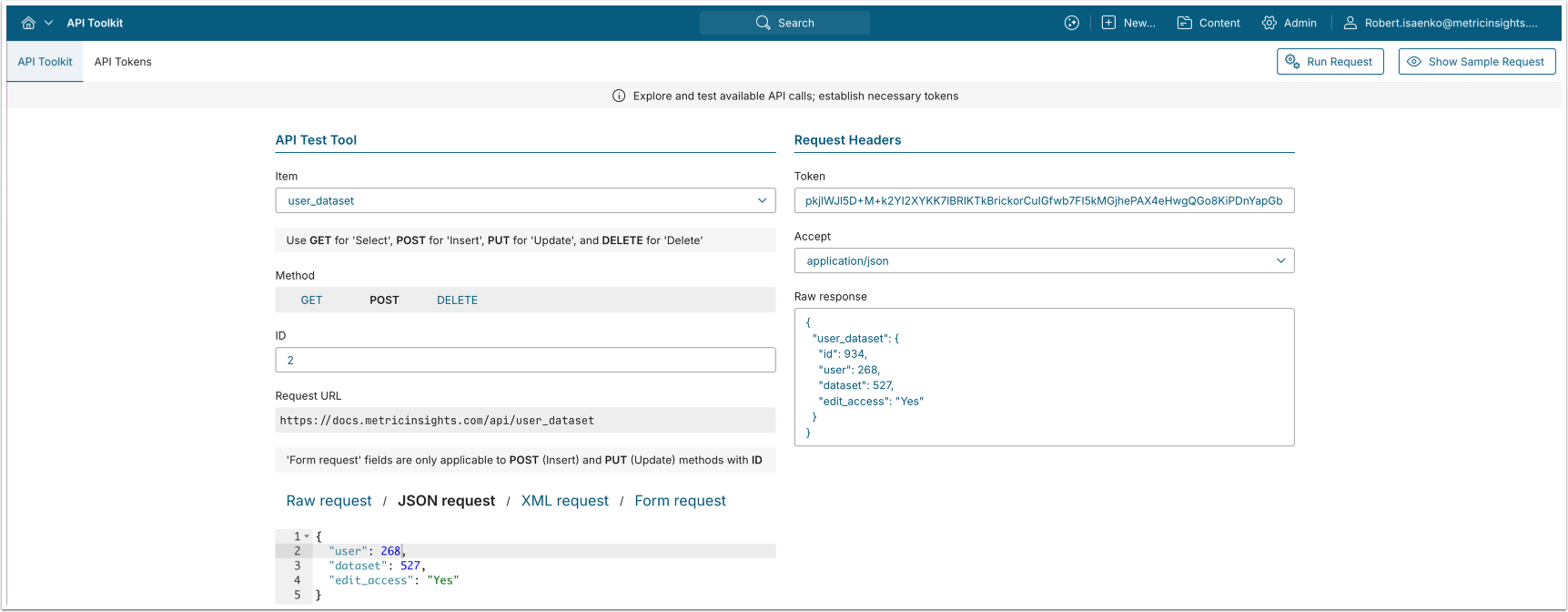
A POST request to /api/user_dataset grants a User access to the Dataset.
- Item: user_dataset
- Method: POST
- Enter the ID of an existing
user_datasetdata entry.- See the Retrieve Users With Access to Dataset section for details.
- Choose JSON request and provide the following values:
- user: The ID of the User to grant access to.
- dataset: The ID of the Dataset.
- edit_access: Whether the User can edit the Dataset. ("
Yes"/"No", optional, default "No".)
- Enter an API Token.
- [Run request]
4.3. Remove User Access from Dataset
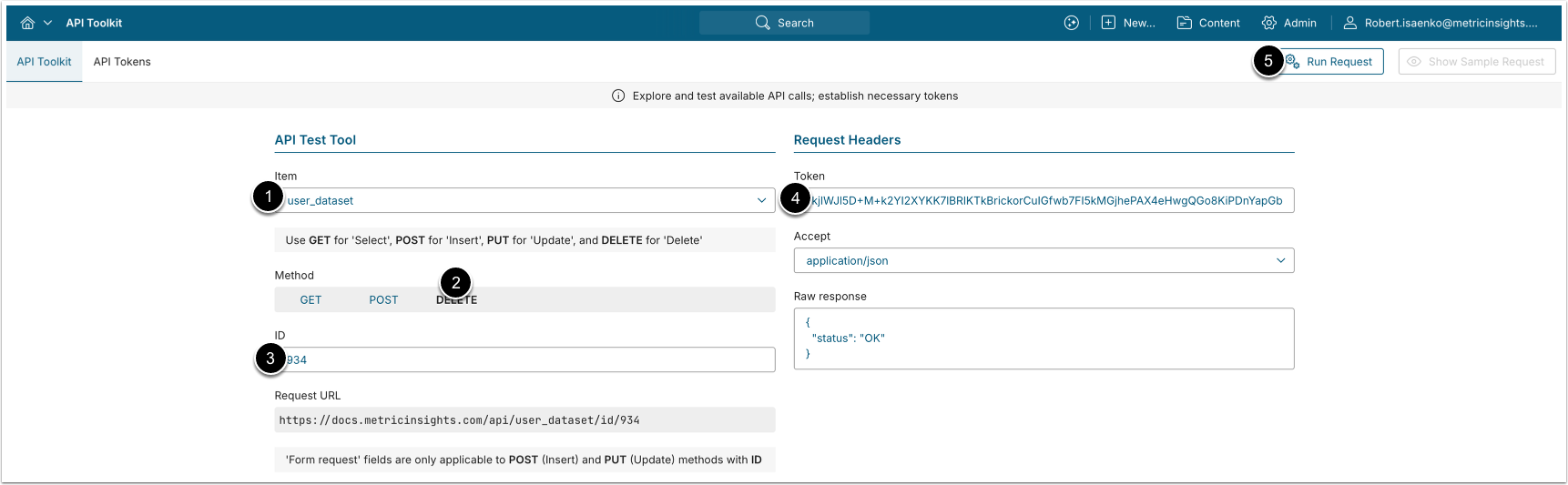
A DELETE request to /api/user_dataset/id/<id> removes a User's access to the Dataset.
- Item: user_dataset
- Method: DELETE
- Enter the ID of the
user_datasetdata entry to be deleted.- See the Retrieve Users With Access to Dataset section for details.
- Enter an API Token.
- [Run request]